
News
An introduction to the IPBES Business and Biodiversity Assessment from its co-chair
Comment | Feb 2026
Ahead of the launch of the Business and Biodiversity Assessment, co-chair Matt Jones explains how this first-of-its-kind report moves the world closer to living in harmony with nature.
There is an old stereotype that people who advocate for the environment and those involved in business sit on different sides of the table, locked into inevitably adversarial positions. That is changing.
The latest science and research enable us to look at this through a new lens, one that stresses how dependent businesses are on nature – instead of just the impact that they have.
The Intergovernmental Platform on Biodiversity and Ecosystem Services (IPBES) has been a huge factor in this change. The Platform – often referred to as ‘the IPCC of biodiversity’ – connects governments with the best available knowledge on biodiversity and ecosystem services. Now, an important leap forward is coming. On 9 February, IPBES will publish the first assessment of the impacts and dependencies of business on biodiversity and nature’s contributions to people – known as the ‘Business and Biodiversity Assessment’.
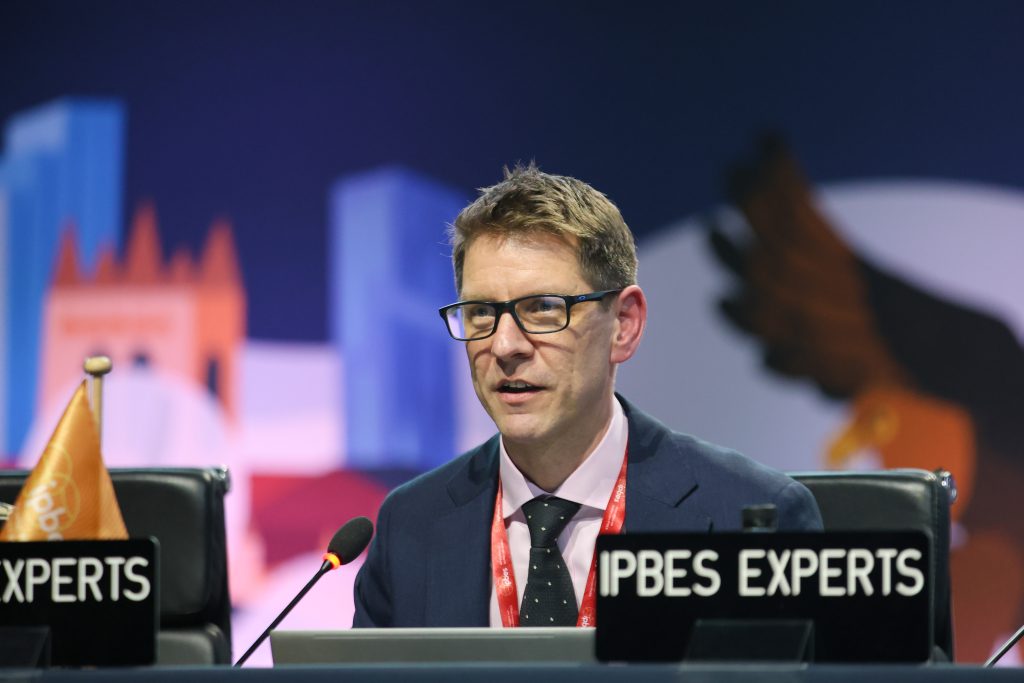
Matt Jones is Chief Impact Officer at UNEP-WCMC and one of three co-chairs for the assessment. Ahead of the launch of the new report, he shares what it seeks to achieve and how its central messages can be woven into every aspect of business operations.
What is the Business and Biodiversity Assessment?
The report is a first-of-its-kind examination into the relationships between business and biodiversity. It assesses the ways businesses depend on as well as impact nature, and the risks those relationships create for both businesses and society. The report draws on over 5,000 sources of information across six chapters. It is distilled into a Summary for Policymakers, which is what representatives from the world’s governments will finalize in Manchester for the 12th IPBES plenary.
It is important to point out that this is a methodological assessment, so it has a focus on the methods that can be used to quantify the relationship between businesses and biodiversity. The report then goes on to explore the actions that can be taken up by businesses, governments, financial institutions and other relevant stakeholders.
How is it different from other IPBES assessments?
This assessment builds on a huge body of work produced through past IPBES assessments, including the landmark global assessment from 2019 that changed the way we understand the risk to businesses from nature loss. The assessment was requested by 150 governments and is the Platform’s first ever “fast-track” assessment to be completed, recognizing the urgency of the issue. It was prepared collaboratively over two years by over 80 experts, from 35 different countries.
The assessment arrives at a critical time, as this is an area where we need urgent and evidence-informed action. The world must find a way to achieve economic growth without further degrading nature. The assessment provides businesses and financial institutions with meaningful guidance on how to understand and measure their nature-related dependencies and impacts, and then how to take action. It also goes into how governments and others can create an environment that enables businesses to act. All this information is vital to transform economies so that they can support people and nature to flourish.
What will businesses and financial institutions gain from the assessment?
The assessment confirms why it is so important for businesses to understand how they are dependent on and impacting nature, and how they might go about doing so and then acting on this understanding. First, it frames these relationships in ways that are compelling. Second, it sets out the methods that businesses can use to understand what good practice looks like, and what data should inform their decisions. Third, it provides concrete options for action, drawing on examples from across the world.
What did your role involve as co-chair of the Business and Biodiversity Assessment?
The three co-chairs are ultimately responsible for delivering the assessment within the scope that was agreed by governments. Together with a group of authors from each chapter, we wrote the Summary for Policymakers, which is the section that is being considered in Manchester this week. In addition to addressing the scope, we have also responded to thousands of comments received from governments and others through a rigorous external review process. We have worked tirelessly to accommodate and reflect all of those points in the version that will be presented to governments soon.
It has been an honour to carry out this important work alongside experts from all over the world, including colleagues from UNEP-WCMC as both authors and additional technical support to the assessment. Throughout IPBES-12 this week, a UNEP-WCMC delegation will represent a wide range of Centre expertise and will be on-hand to contribute to the process.
Finally, as co-chair, what excites you most about this assessment?
At the start of my career, it was challenging to make a business case for nature action to executives. The global economy is set up to extract from nature, and we saw that in the IPBES Global Assessment in 2019, which made clear that biodiversity loss is a risk to our global economy. The idea that this threatens society and business as usual has changed how businesses engage.
So, this Assessment comes at a critical moment. We’ve seen huge momentum to develop metrics, methods, tools and approaches for businesses. This energy and momentum is what we need. But we must guard against the potential confusion it creates that can prevent people from acting. This Assessment will not answer every question, but it will bring clarity and coherence to what it means for a particular methodology to be fit for purpose and what success looks like. I think in years to come we will see these themes from the Assessment being woven into business decisions and practices, and that is incredibly exciting.
Main image: IISD/ENB | Anastasia Rodopoulou
Have a query?
Contact us
communications@unep-wcmc.org